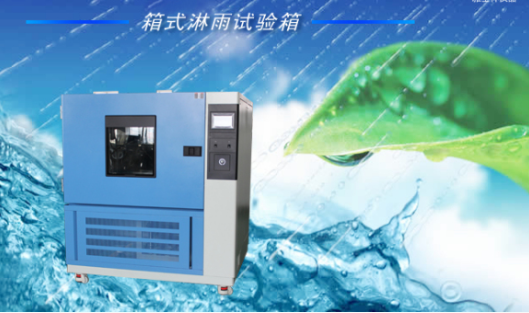
In today’s environment of increasingly stringent product quality and reliability requirements, ensuring stable product performance under harsh weather conditions has become a critical challenge for manufacturers. Water ingress due to rain remains one of the most common causes of product failure. As a specialized environmental reliability testing tool, the rain test chamber delivers exceptional value by accurately replicating a wide range of natural rainfall conditions, providing a scientific and authoritative basis for validating product water resistance.
I. Comprehensive Simulation for Complex Rain Challenges
A rain test chamber does far more than simply spray water. It is designed to meet rigorous national and international standards—such as IEC, IP ratings, and GB/T—to achieve a high-fidelity reproduction of real-world rainfall conditions. The key types of rain environments it can simulate include:
-
Continuous moderate to heavy rain: This simulates long-duration, uniform rainfall to test a product enclosure’s resistance to sustained water ingress. It is especially critical for outdoor cabinets, telecom base stations, automotive lighting, and other products exposed to prolonged rain.
-
Variable angle and directional spray: Natural wind-driven rain comes from multiple directions. Advanced rain test chambers are equipped with adjustable spray systems that can deliver water vertically, horizontally, or at any set angle, replicating real-world wind-and-rain conditions and allowing comprehensive evaluation of all sides of a product.
-
High-intensity downpours and water jet impact: For products requiring higher ingress protection ratings (e.g., IPX5, IPX6), the chamber can simulate high-flow, high-pressure jet or powerful water spray. This is essential for validating vehicle components, outdoor surveillance equipment, and other products against extreme weather and water pressure.
-
Extension to immersion testing (IPX7/X8): Some integrated rain test chambers also support short-term or prolonged immersion tests, verifying whether a product’s enclosure prevents harmful water ingress at specified depths and durations.
II. Core Value: Boosting Product Competitiveness at the Design Stage
Integrating rain test chamber testing early in development provides value far beyond simply identifying issues:
-
Improves design reliability: By simulating rain scenarios during the R&D phase, manufacturers can detect weaknesses in sealing design or material selection early, effectively avoiding costly field complaints and recalls due to water ingress.
-
Accelerates certification: In-house rain testing capability significantly shortens the time required for third-party IP rating certification, speeding time-to-market.
-
Enhances brand reputation: Products validated under rigorous rain conditions demonstrate outstanding reliability and durability—powerful drivers of customer trust and a strong brand image.
The rain test chamber serves as a bridge between product design and real-world operating environments. By scientifically simulating diverse rainfall conditions, it empowers manufacturers to anticipate risks, validate quality, and strengthen competitiveness. Investing in professional rain testing provides a solid foundation for long-term product success.