In the field of materials corrosion testing, salt spray testing is a core method for evaluating product durability. However, many users may not fully appreciate that spray particle size—a parameter that appears minor—has a decisive impact on the accuracy, repeatability, and comparability of test results. Precise control of spray particle size is fundamental to ensuring the authority of any testing regimen.
Why Is Spray Particle Size So Important?
Salt spray testing accelerates material aging by simulating corrosive conditions found in marine or industrial environments. Spray particle size directly determines the deposition behavior of salt fog on specimen surfaces and the resulting corrosion mechanisms:
-
Effect on deposition uniformity: Droplets that are excessively large tend to settle rapidly due to gravity, leading to uneven spatial distribution within the chamber. This results in significant differences in corrosive media exposure between the upper and lower surfaces of specimens, distorting the outcome. Conversely, droplets that are too fine may remain suspended in the air, making it difficult to effectively cover the specimens and prolonging the test cycle. The ideal particle size range—typically 1 to 5 microns—ensures that the salt fog disperses uniformly, subjecting every specimen surface to a consistent corrosive challenge.
-
Effect on corrosion rate and mechanism: Particle size influences the wettability and residence time of droplets on specimen surfaces. Larger droplets tend to form continuous films, which are more conducive to uniform corrosion, while finer droplets are more likely to accumulate at surface defects, initiating pitting or crevice corrosion. Improper control of particle size can cause a material that should exhibit uniform corrosion to be mistakenly judged as having poor pitting resistance, thereby misleading product improvement efforts.
-
Determination of compliance with testing standards: International standards such as ASTM B117 and ISO 9227 explicitly specify the median particle size and collection rate of the salt spray. Deviation from the specified particle size—even if all other chamber parameters are precisely maintained—will prevent test results from receiving international recognition, affecting product certification and market access.
How Do We Ensure Precision and Stability in Spray Particle Size?
As a specialist in environmental testing equipment, we have elevated the control of spray particle size to a new industry standard through technological innovation and precision manufacturing:
-
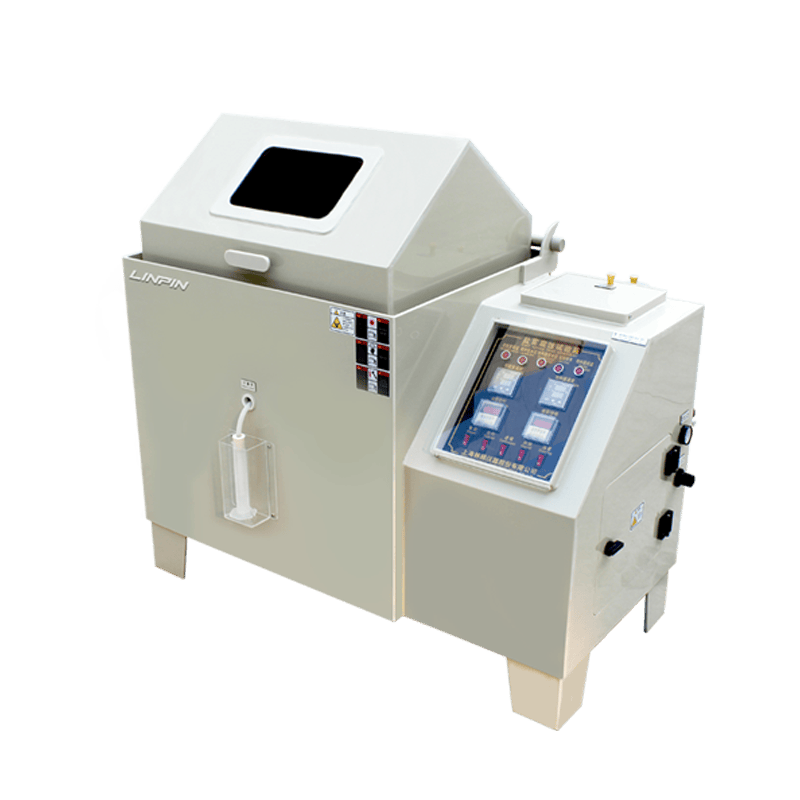
Core atomization technology: We employ high-performance titanium alloy or glass nozzles combined with a precision pneumatic regulation system to generate salt fog with particle sizes concentrated within the optimal 1–3 micron range, with a coefficient of variation below 10%—far exceeding standard requirements.
-
Intelligent closed-loop control: Built-in real-time particle size monitoring sensors are integrated with the control system. Should any particle size drift be detected, the system automatically adjusts air pressure and temperature to maintain consistent spray conditions throughout the entire test.
-
Repeatability and comparability assurance: Each unit undergoes rigorous factory calibration and is shipped with a particle size distribution test report. This ensures that results are highly repeatable—whether across multiple test runs of the same product or across different laboratories using our equipment—providing reliable data support for R&D and quality control decisions.
Selecting a salt spray test chamber involves far more than simply considering temperature range or chamber dimensions. Precise control of spray particle size is a core indicator of the equipment's true capability and directly affects the accuracy of your product quality assessments. We are committed to delivering not just equipment that meets standards, but test data that withstands scrutiny and deeper quality insights that drive better decision-making.